> ## Documentation Index
> Fetch the complete documentation index at: https://docs.rkat.ai/llms.txt
> Use this file to discover all available pages before exploring further.
# Introduction
> MobKit — build advanced multi-agent systems with a few lines of code. Orchestrate groups of Meerkat agents with built-in routing, lifecycle management, and operational tooling.
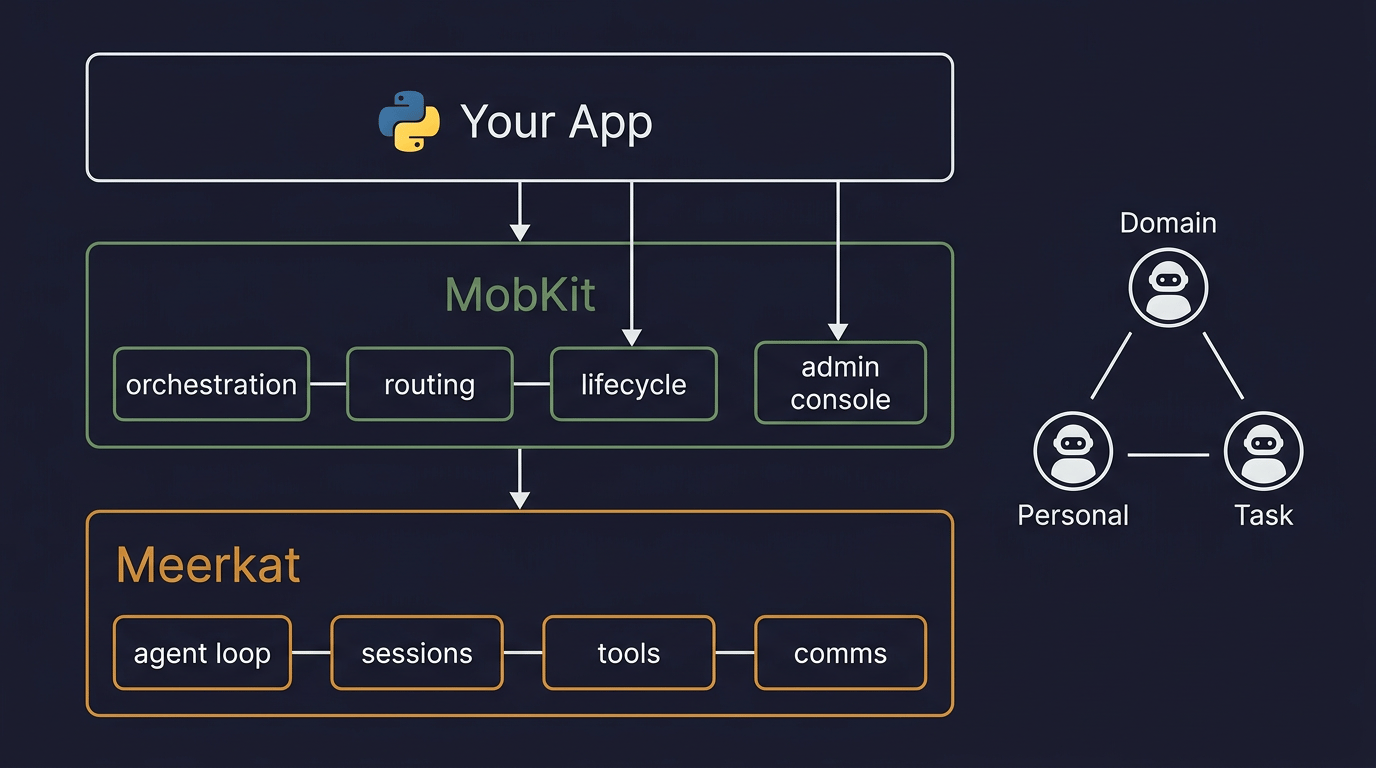
MobKit lets you stand up a production multi-agent system in a few lines of code. You describe the agents you want, how they connect, and what operational capabilities they need — MobKit handles the rest: spawning, wiring, routing, lifecycle management, and a live admin console.
It builds on [Meerkat](https://github.com/lukacf/meerkat), which provides the agent runtime (prompt assembly, tool dispatch, sessions, the core agent loop). MobKit adds the orchestration layer that turns individual agents into coordinated groups.
```python theme={null}
rt = await (
MobKit.builder()
.mob("mob.toml")
.persistent_state("./state")
.roster(my_roster)
.gateway("./rpc_gateway")
.build()
)
triage = rt.agent("triage:main")
luka = rt.agent("identity:luka")
await triage.dispatch_text("New event", origin="connector")
await luka.send("What's happening?")
output = await luka.wait_for_output(timeout=60)
```
 ## What you can build
MobKit's primary pattern is layered agent architectures — but it's not limited to any single topology:
* **Domain agents** that own a capability (email, calendar, code review, data analysis)
* **Personal agents** that represent a user and delegate to domain agents
* **Group agents** that coordinate across a team or initiative
* **Task agents** that are spawned on demand for short-lived work
You define agents as profiles in a mob config, wire them together with peer connections, and MobKit handles the lifecycle: spawning at startup, retiring when no longer needed, respawning on failure, and reconciling the roster when your desired topology changes.
## What MobKit provides
* **Orchestration.** Bootstrap an entire mob and its operational modules in a single call. Process supervision, health gates, and configurable restart policies.
* **Identity-first continuity.** Durable agent identities with roster providers, topology-aware prompts, non-destructive respawn, destructive reset, and in-process reconciliation. Agents survive restarts with stable session IDs.
* **Roster management.** List, inspect, spawn, retire, and respawn members. Ensure agents exist before sending them work. Reconcile the roster against a desired state.
* **Operational subsystems.** Message routing with sink adapters, risk-based approval gates, cron scheduling with timezone support, and semantic memory — all wired in as supervised modules.
* **Admin console.** React web UI with agent sidebar, activity feed, chat inspector, topology view, and health overview — all updating in real time via SSE.
* **Session persistence.** JSON file storage for development, BigQuery adapter for production. Complements Meerkat's own runtime-backed session durability.
* **Authentication.** JWT/OIDC validation with JWKS discovery and email allowlists. Google, GitHub, Generic OIDC, and Service Identity providers.
* **SDKs.** Python and TypeScript SDKs with typed returns and contract parity tests against the Rust core.
## MobKit and Meerkat
| | Meerkat | MobKit |
| ------------- | ----------------------------------------------------------- | -------------------------------------------------------------- |
| **Role** | Agent runtime — runs individual agents | Orchestration — coordinates groups of agents |
| **Owns** | Agent loop, prompt assembly, tool dispatch, sessions, comms | Startup, routing, lifecycle management, operational subsystems |
| **Interface** | Library crate, CLI, REST, RPC, MCP | Library crate, JSON-RPC, admin console, SDKs |
Meerkat is the engine that makes each agent work. MobKit is the toolkit that makes them work together.
## Explore the documentation
Bootstrap a runtime with modules and a Meerkat mob in under a minute.
Modules, events, gating, delivery, scheduling, memory, and sessions.
Step-by-step walkthroughs for the unified runtime, module system, and console.
Internal architecture, crate structure, and design decisions.
JSON-RPC, REST, and SSE protocol references.
Rust, TypeScript, and Python SDK documentation.
## What you can build
MobKit's primary pattern is layered agent architectures — but it's not limited to any single topology:
* **Domain agents** that own a capability (email, calendar, code review, data analysis)
* **Personal agents** that represent a user and delegate to domain agents
* **Group agents** that coordinate across a team or initiative
* **Task agents** that are spawned on demand for short-lived work
You define agents as profiles in a mob config, wire them together with peer connections, and MobKit handles the lifecycle: spawning at startup, retiring when no longer needed, respawning on failure, and reconciling the roster when your desired topology changes.
## What MobKit provides
* **Orchestration.** Bootstrap an entire mob and its operational modules in a single call. Process supervision, health gates, and configurable restart policies.
* **Identity-first continuity.** Durable agent identities with roster providers, topology-aware prompts, non-destructive respawn, destructive reset, and in-process reconciliation. Agents survive restarts with stable session IDs.
* **Roster management.** List, inspect, spawn, retire, and respawn members. Ensure agents exist before sending them work. Reconcile the roster against a desired state.
* **Operational subsystems.** Message routing with sink adapters, risk-based approval gates, cron scheduling with timezone support, and semantic memory — all wired in as supervised modules.
* **Admin console.** React web UI with agent sidebar, activity feed, chat inspector, topology view, and health overview — all updating in real time via SSE.
* **Session persistence.** JSON file storage for development, BigQuery adapter for production. Complements Meerkat's own runtime-backed session durability.
* **Authentication.** JWT/OIDC validation with JWKS discovery and email allowlists. Google, GitHub, Generic OIDC, and Service Identity providers.
* **SDKs.** Python and TypeScript SDKs with typed returns and contract parity tests against the Rust core.
## MobKit and Meerkat
| | Meerkat | MobKit |
| ------------- | ----------------------------------------------------------- | -------------------------------------------------------------- |
| **Role** | Agent runtime — runs individual agents | Orchestration — coordinates groups of agents |
| **Owns** | Agent loop, prompt assembly, tool dispatch, sessions, comms | Startup, routing, lifecycle management, operational subsystems |
| **Interface** | Library crate, CLI, REST, RPC, MCP | Library crate, JSON-RPC, admin console, SDKs |
Meerkat is the engine that makes each agent work. MobKit is the toolkit that makes them work together.
## Explore the documentation
Bootstrap a runtime with modules and a Meerkat mob in under a minute.
Modules, events, gating, delivery, scheduling, memory, and sessions.
Step-by-step walkthroughs for the unified runtime, module system, and console.
Internal architecture, crate structure, and design decisions.
JSON-RPC, REST, and SSE protocol references.
Rust, TypeScript, and Python SDK documentation.